Showing posts with label UNIT 4: THE EARTH. Show all posts

Tuesday, December 11, 2012

Let's make a volcano explode!!!!!!

We have made an experiment today, a volcanic eruption.
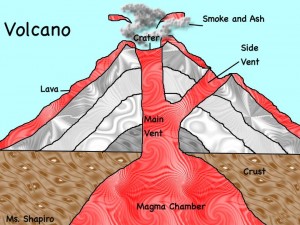
 The teacher has explained how she made the volcano and she has explained its parts so we have reviewed some vocabulary of the unit: crater, volcanic cone, lava, magma chamber, volcanic chimney...

This is the model of our volcano. It has a bottle inside.
It has been very easy.We have used baking soda, vinager and colorant.
First, we have put some baking soda in the volcano.


Then, we have added the vinager mixed with the colorant. We used food colant and tempera to dye the vinager.

You do not have to wait...in several seconds the volcano explodes!!!!!

Saturday, December 8, 2012

EARTHQUAKES

  •  Earthquakes involve the powerful movement of rocks in the Earth’s crust. The rapid release of energy creates seismic waves that travel through the earth.
  • Scientists use the different speeds of seismic waves to locate the epicentre (the point on the surface directly above where the earthquake originated) of earthquakes.
  • Seismometers are used to measure the magnitude of earthquakes. You are unlikely to feel a magnitude 3 earthquake but a magnitude 6 earthquake could potentially cause large damage.
  • The damage caused by earthquakes also depends on their depth and fault type.
  • The most powerful earthquake ever recorded on Earth was in Valdivia, Chile. Occurring in 1960, it had a magnitude of 9.5.
  • It is important in earthquake prone countries such as Japan to build houses and buildings that react well to earthquakes. Good engineering practises can help stop buildings collapsing under the stress of large earthquakes. 
What causes earthquakes to happen? This brief animated video describes the Earths slow-moving tectonic plates. 
Why do earthquakes happen?


VOLCANOES


If you follow these links clicking on the images on the left, you could find some interesting web pages. You will learn lots of facts about volcanoes there.


PARTS OF A VOLCANO
VÍDEO ABOUT VOLCANOES


Monday, December 3, 2012

WEATHERING AND EROSION

Here you are a video to learn more about weathering and erosion, it is very fun and interesting.Weathering and erosion shape the world that is around us. Watch and listen as Zoe and RJ from the StudyJams Crew explain the science behind weathering and erosion.

ROCKS: TYPES AND CYCLE

Here you are a link to a web page where you can find information about the three types of rocks (IGNEOUS, SEDIMENTARY AND METAMORPHIC) and the rock cycle. Click on the image above.

 If you click on this image above you could explore the diagram of the rocks cycle by rolling your mouse over the names of the rock types and clicking on the images. Can you name the different parts of the rock cycle?


You can also watch this video about the topic.

Friday, November 30, 2012

SCIENCE DISPLAY FOR UNIT 4

   This is our Science display. Here you can see some of the projects for Unit 3. It is about the ENVIRONMENT. 
   There are posters and crafts. Some are about the ecosystems, others show food chains or food webs. Some others are about recycling or protecting the environment...
   In this blog you can have a look at the PPT or digital Projects made by the students of year 5.
We hope it like you.

Sunday, November 25, 2012

EARTH'S STRUCTURE

http://www.learner.org/interactives/dynamicearth/structure.html

THE EARTH'S LAYERS


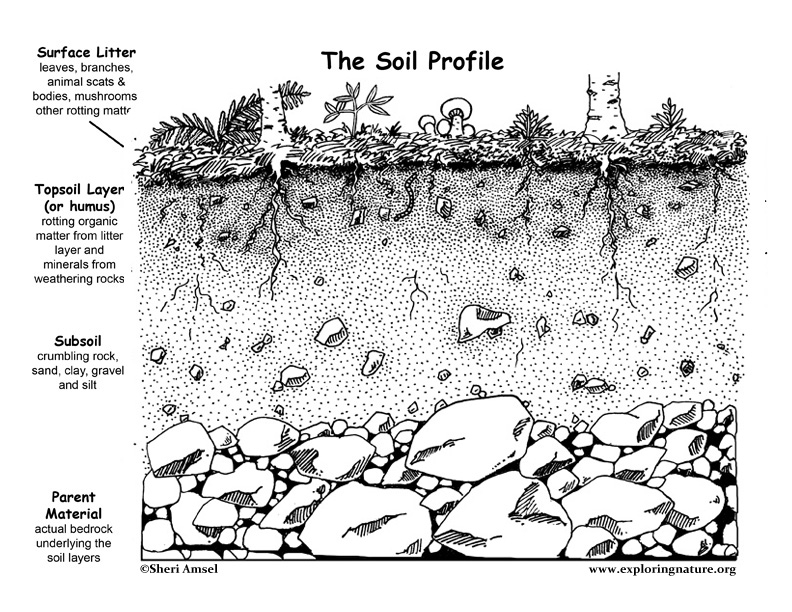
SOIL


ROCKS

The rocks you see around you - the mountains, canyons & riverbeds, are all made of minerals.
A rock is made up of 2 or more minerals.
Think of a chocolate chip cookie as a rock.
The cookie is made of flour, butter, sugar & chocolate.
The cookie is like a rock and the flour, butter, sugar & chocolate are like minerals.
You need minerals to make rocks, but you don't need rocks to make minerals.
All rocks are made of minerals.

MINERALS

A mineral is composed of the same substance throughout.
If you were to cut a mineral sample, it would look the same throughout.
There are about 3000 different minerals in the world.
Minerals are made of chemicals - either a single chemical or a combination of chemicals.
There are 103 known chemical elements. Minerals are sorted into
8 groups. Some common examples have been listed for each.